
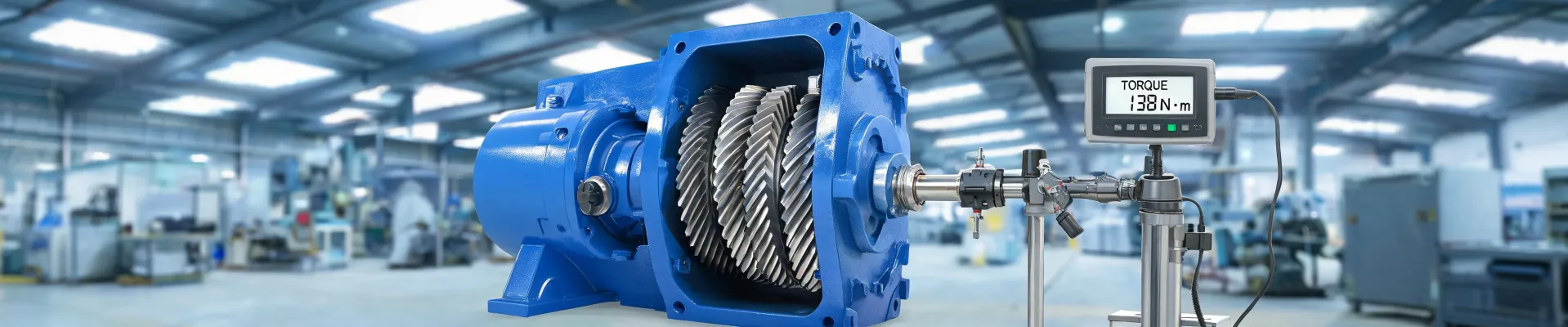
It usually starts with a grinding noise
In early 2024, I got a call from a site manager at 10 PM on a Thursday. His concrete mixer — a mid-size truck-mounted unit — had seized up mid-pour. The crew was idle, the concrete was setting, and the client was furious. Normal turnaround for a gearbox repair? About 3 days. He needed it running by Saturday morning. That's roughly 36 hours.
When we opened the box, the culprit was obvious: a cheap replacement worm gear that had sheared teeth. The operator had bought it online for a fraction of the OEM cost. Saved maybe $150. But the downtime, the lost concrete, the rushed repair fees, and the penalty clause for missing the pour slot? Over $12,000.
I've seen this pattern maybe 30 times in my career. Every time, it boils down to the same misunderstanding about what a gearbox part actually does.
What you think the problem is
Most people assume gearbox failures are random — bad luck, or maybe the machine's just old. When a concrete mixer stops turning, the first instinct is to find any replacement part that fits and get back to work. After all, $50 for a gear vs. $250 for a genuine Bonfiglioli part? Easy choice. Right?
Wrong. And here's why.
The real problem isn't the gear — it's the mismatch
Concrete mixer gearboxes operate under brutal conditions: high shock loads, constant start-stop, vibration, dust, and temperature swings. A gear that 'fits' dimensionally may differ in material grade, heat treatment, tooth profile, or backlash tolerance. That difference might not show up in the first week. But after 200 hours of mixed concrete loads, the stresses concentrate on the wrong spots — and then the teeth start cracking.
It took me about 4 years and roughly 50 failure analysis reports to understand that the root cause isn't wear — it's incompatible quality. The cheap part looks like the original, but it behaves like a completely different component under load. (Which, honestly, should have been obvious — but when you're under pressure to fix things fast, you grab what's available.)
The cost of 'saving' on a gearbox part
Let me break down the real cost of choosing a non-OEM or low-quality replacement for a Bonfiglioli gearbox in a concrete mixer.
| Cost factor | Cheap part | Original/Bonfiglioli-grade |
|---|---|---|
| Part price | $80–120 | $250–400 |
| Installation labor | $200 (same) | $200 |
| Expected life | 6–12 months | 3–5 years |
| Downtime risk | High — unpredictable failure | Low — predictable |
But that direct comparison misses the bigger picture. When I compared our Q1 and Q2 results side by side — same fleet, different sourcing strategy — I realized we were spending 40% more on emergency repairs than on planned maintenance. The cheap parts didn't save money; they created emergencies.
And emergency repairs have hidden multipliers:
- Rush shipping fees (often 2–3x standard)
- Overtime labor (weekend or night shift rates)
- Lost production (the concrete being mixed is often ruined, or the pour is delayed)
- Client penalties (some contracts specify $500–$2,000 per hour of downtime)
I'd guess — and I admit I don't have hard data on industry-wide averages, but based on our own records — the total cost of a single cheap-gearbox failure usually exceeds $5,000. For a $150 'saving.' That math never adds up.
Why quality affects more than just your wallet
Here's the part that surprises most operators: the client's perception of your business. When a mixer breaks down on site, the contractor remembers not just the delay, but the unprofessionalism. They tell other contractors. Your brand becomes associated with unreliable equipment.
I once had a contractor tell me, 'I'll never hire that company again — their truck broke down in the middle of my slab.' That company had saved $300 on a worm gear. They lost a $200,000 annual contract. The gearbox itself? It was a generic replacement for a Bonfiglioli unit.
This is the core insight I've come to after 5 years of managing fleet maintenance: the part you choose is a direct reflection of your brand. If you're okay with cheap, inconsistent parts, your clients will see you as cheap, inconsistent. If you use genuine or high-quality alternatives, you signal that you value reliability. It's that simple.
What actually works (the short version)
By now you've probably guessed the answer. But let me be direct:
- For concrete mixer gearboxes, use OEM or high-quality replacements that match the original Bonfiglioli specs in material and tolerance. This is especially critical for planetary stages and worm gear pairs.
- For DC servo motors (which also appear in many machines), the same principle applies — cheap servos drift calibration and lose torque over time.
- For linear bearings like LM8UU, the bearing ball grade and rail straightness matter more than you'd think. A 30% cheaper linear bearing might introduce 0.02mm play — that's enough to cause vibration in a mixer's discharge mechanism.
I can only speak to the heavy equipment world I work in. If you're dealing with induction motor furnaces or ultra-high-temp environments, the calculus might be different. But for general concrete mixing, the pattern is consistent.
One practical tip: if you're sourcing parts for a Bonfiglioli gearbox (common models for mixers include the HD series or the planetary 300 series), cross-reference the part number against the official catalog. A 5-minute check can save you a $5,000 failure later.
And when you do need a rush replacement? Call ahead. Build relationships with distributors who stock genuine parts. Yes, it costs more upfront. But after handling 40+ emergency orders last year, I've learned that the cheapest option is almost never the fastest — not when you count the rework.